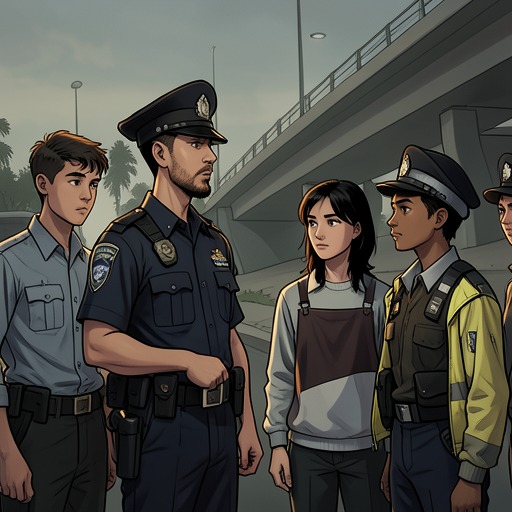
La rixe des Jets et des Sharks sous l’autoroute
West Side StoryLa rixe des Jets et des Sharks sous l’autoroute turns a gang rivalry already sharpened by police pressure and ethnic hostility into a fatal confrontation. The fight’s decisive change is not simply that a challenge becomes physical: Riff Lorton and Bernardo die, Tony Wyzek is drawn into the violence, and the police arrive only after the struggle has become irreversible.
Causes and immediate background
The confrontation takes place in a climate of official suspicion as well as rivalry between the Jets and the Sharks. Schrank, a police officer with three decades on the force, believes that people are generally corrupt and that troublemakers must be controlled with force. He threatens the boys with punishment, grips Riff Lorton’s shoulder painfully, and insists that the street does not belong to them. He orders them to remain on their own block and stop obstructing the sidewalk, presenting restriction as the answer to raids and explosions between the gangs.
Schrank’s conduct gives that order a personal and openly hostile edge. At another encounter, he smokes in the room, addresses Bernardo and the other Latinos as people he can expel by invoking his badge, and directs them toward the door. He then presses the Jets to disclose where they intend to fight, naming possible locations and claiming that he wants to clean up the streets as they do. When they do not answer, his appeal turns into threats and ethnic insults aimed at the boys and their families. The policing on display is therefore not a neutral interruption of the feud: Schrank alternates between asserting control over both groups and using contemptuous categories that intensify their antagonism.
From challenge to knife fight
The immediate clash begins when Riff Lorton pushes Tony Wyzek aside and attacks Bernardo. Bernardo answers with a blow, then draws his knife. He signals the Sharks to stay back, leaving the two leaders to face each other rather than turning the encounter at once into a group attack. Riff also has a knife. Their movements are cautious and practiced: they maneuver for position, feint, and circle defensively, each aware that a knife fight can be decided in a very small number of exchanges.
Tony Wyzek tries to stop the confrontation, but Action and Diesel hold him back. Around the fighters, the circle tightens. When Action and Diesel briefly loosen their grip, Tony gets free; by then, however, the duel has already reached its decisive beat. Riff Lorton calls for him to move back and makes a broad gesture with his arm. That movement gives Bernardo the opening to strike. The sequence makes the interruption tragically belated: Tony’s attempt to intervene does not prevent the duel, and the movement associated with Riff Lorton’s warning leaves him exposed.
Deaths and dispersal
Riff Lorton is killed before he reaches the ground. Tony Wyzek takes the knife from his hand and charges Bernardo, who is fatally struck and collapses. The reversal is immediate: Tony’s effort to hold back from the fight gives way to a lethal response after his friend’s death. The violence does not resolve the rivalry or restore control; it adds two deaths to a conflict that had already been framed as a struggle over territory and belonging.
A siren sounds, and a patrol car stops above the scene. Its light sweeps across the side of the highway as the Jets and Sharks scatter. Diesel pulls Tony Wyzek away by the arm. Blinded by tears as he runs, Tony repeatedly calls out the girl’s name; the sirens are the only answer. The scene thus ends not with a victor claiming the ground, but with flight, police presence, and Tony’s attention fixed on someone absent from the fight.
Narrative significance
The episode brings together forms of pressure that have been visible before the knives appear. Schrank’s orders reduce the boys’ freedom of movement to a block-by-block restriction, while his language treats them as troublemakers or immigrants before their individual actions are considered. Yet the confrontation is not presented as something imposed by the police alone: Riff Lorton attacks Bernardo, the two leaders continue the armed duel, and Tony Wyzek’s response kills Bernardo. The context clarifies the environment of hostility without erasing the participants’ actions or the consequences of their choices.
The fight’s structure also depends on the gap between intervention and outcome. Tony Wyzek attempts to break up the conflict, is restrained, then escapes only as the circle closes around the two fighters. His moment of freedom arrives too late to save Riff Lorton, and his next action deepens the loss rather than undoing it. The patrol car’s arrival ends the gathering but cannot reverse what has happened. In that turn from threatened confrontation to fatal loss, the scene makes the cycle of violence concrete: police intimidation and gang hostility frame the encounter, but the final consequences fall on the young men who remain inside it.